Sunday, November 10, 2013

October 17 and 18, Shanghai


Writing this at night in Shanghai, I'm still coldy (medical term, you understand) but rested. I decided to skip the first day's activities and meet the half-dozen people on the Shanghai part of the trip for dinner tonight. It's been lovely spending the entire day in bed, reading and sleeping, except for a short time this morning going down for breakfast -- and of course going back to the bank next door to retrieve my debit card. They were expecting me to come for it, a process that involved signing a form and giving them my passport to copy. I can't imagine what they are going to do with those pieces of paper.

I have just come back from dinner and have met the other six people on the Shanghai part of the trip. They are three couples. I sat next to the husband of a couple from Charleston SC, who recently retired as a dean at Ohio University. There is a gay couple, two men from Los Angeles, for whom this is their twentieth Overseas Adventure Travel trip, astonishing. There is a couple from North Fort Myers FL; I took an instant dislike to his challenging-clowning manner but then discovered he loves classical music and opera, so I decided maybe he's not so bad after all. The judgments we make of people!


October 18, Shanghai

Today was my first full tour day. I'm afraid I am not designed for tour groups. Although there are only seven people in this group plus Mike, the tour leader, I am finding that what I am able to learn about China from a Chinese person doesn't compensate for not being able to go at my own pace and poke into things that interest me for as long – or short – as I like. There is no question, though, that having someone else take care of the logistics of traveling is a blessing. Well, one day is not very much to draw such a sweeping conclusion from, is it?

We went in a van to Zhu Jia Jiao, an old water town like Tongli but not as thoroughly commercialized and touristy as Tongli. It was actually a very beautiful town. Walking along the old streets we saw tubs of turtles, from tiny to medium, that supposedly symbolize long life and prosperity. I'm not sure there is anything in China that doesn't symbolize long life and prosperity, frankly.


This being fall, it is soft-shell crab season. I was told these are the common ones that sell for maybe a dollar apiece, but there is another very fancy type which rich people reserve when they are perhaps an inch big and wait for half a year for them to reach full size, at which time they are sold by weight often at $80 or so apiece. Is the taste that much better? I wanted to know? Absolutely, said Mike.


We saw a woman making Chinese tamales! Here they use bamboo leaves, not corn husks, and fill them with uncooked rice and some kind of meat, and then boil them for three hours.


 It's a lovely town, which I hope these pictures from the boat ride we took manage to convey.


Then we went to lunch. Every meal I've had with this group has been in a restaurant that seems to have only very big round tables, for eight or ten people. I'd imagine if you were one or two or three it might be lonely at such a big table. Each table has an enormous glass lazy susan in the center for the dishes. Like the lunch I had with Shell in Hangzhou, the server brought out dish after dish after dish. It is necessary to take seconds and thirds and even fourths because plates are the size of a saucer. Although the food so far has been delicious I suspect this is not the particularly interesting food I had hoped for: no turtle or turtle-equivalent! And getting the hang of the lazy susan is an acquired skill just as chopsticks are: you can't turn it unless you first make sure someone across the table is not helping themselves to something or else they are left holding the fork in mid-air. Oddly, serving forks, not serving spoons.

Then on to a garden, which used to be in the private home of a rich family. Not Suzhou-quality but still lovely, as was this path:

In the garden was a shop of silk-embroidered pictures as I had seen them in Suzhou. There was a set of four very simple and elegant ones, which I bought. Here are two of them, with a picture of the artist who made them.


Then a long traffic-clogged ride back to Shanghai. I am constantly amazed at the prosperity the cars here indicate: Audi, BMW, Porsche, Lexus. In Hangzhou I passed a Maserati dealer. Shanghai is a free-trade zone, so I am curious to see how different other places in China will be. This is certainly not my idea of a restricted Communist economy!

We had dinner near the river and then boarded a boat for a view of Shanghai at night. I took some pictures but don't know if I can begin to convey what it was like. Think back to the most over-the-top display of Christmas lights you've ever seen in your life – a neighborhood, a particular house. Downtown Shanghai is like that multiplied by about a million. I cannot begin to imagine the cost in electricity to run all these lights. 


Some huge modern office buildings, looking like they are 50 stories tall, use their facades as digital canvases, with decorative lights or just plain advertising playing over them as if they were a projector.

The gaudily-lit tour boats vied for space on the river with huge freighters and barges that were all but invisible in the night, having only one light bulb.


The colors, the liveliness of it all took my breath away. The riverbank was lined with people just looking at the passing entertainment, as the people on the boats watched the people on the riverbank. Quite a show.

October 16, Hangzhou


News flash: I got an email from my friend Luba, who writes:

Conde Naste, the world's #1 travel magazine, just named San Miguel de Allende the best city in the world. Check it out! http://www.cnn.com/2013/10/16/travel/cn-traveler-top-cities/

It shouldn't matter, but I feel validated!

This morning I met Shell at her school building, who is one presentation to her teacher on pre-Raphaelite art away from getting her Bachelor's degree in Art History. Here is Shell:


First we went up to her classroom to drop off my backpack for the day. There were two other students in there, studying by themselves. It was a large room with windows on two sides, provided with thick curtains so that projected visuals could be seen. There were about 30 desks arranged in rows, like old-fashioned elementary schools. The room was shabby, messy and dirty: depressing. We left and walked about four blocks to West Lake, Shell holding my elbow or my arm everywhere we walked: an honored elder thing which I figure by now I've earned. On the way we passed one of the many rent-a-bike stands, but here you can rent not only a bike with one seat but bikes with two or even three seats. And with or without canopies!


West Lake is so spectacular partly because it's surrounded by heavily wooded hills – which people here call mountains. (Coming from Seattle, my notion of mountain means “snow on the top.”) Without an airplane it's impossible to give you a sense of the panorama of West Lake which is very big, so these two will have to do.


I enjoyed Shell's company very much and certainly enjoyed the beauty of the lake, but was aware that my experience of the lake itself was not as profound as my experiences of the Suzhou gardens had been: the lack of solitude made a significant difference. I mean Shell's presence, not that of others, and the necessity to make conversation, interesting though it was. 

 The lake not only attracts tourists from all over China and other countries but is also a hub of local life, especially for retired people. We came across a large group of them listening to an impromptu singing performance, like a talent show. For pleasure or for money? I asked Shell. For pleasure. These two women were accompanied by three men playing traditional Chinese musical instruments. With amplifiers.


At the end of a song, very few people applauded. In fact, many people just seemed to be staring glumly into space, like the people in the background of this picture. Shell tells me that Chinese people don't normally smile but do respond to a smile with a smile, something I've certainly noticed: they smile at me a lot.

At another place, they were dancing. In each place the sound volume of the music was turned up to ear-splitting.


Although the surroundings were sublime, I surely do hope these folks have more to do in their retirement years than this. They certainly didn't look very happy, but perhaps a glum expression means something different here.

Shell insisted on taking me out to lunch, even though I protested she is a poor art student. She pointed out that when other guests come to visit her she does this. Okay. The restaurant she took us to, not on the lake, had tables under umbrellas on a patio. I asked her to order anything she thought was especially Chinese – I am game for anything. I could not believe the amount of food she ordered:


You can see the little wooden teacup, holding maybe two ounces of tea, and four of the maybe eight dishes she ordered. In the northeast with a flame under it to keep it warm was a cabbage dish; I think steamed first then mixed with a sauce. At the northwest was a Hangzhou specialty, pork with potatoes underneath. If you imagine a piece of bacon not 1/8 of an inch thick but instead two inches thick and then stewed in the sauce, that's it. I managed not to think of the fatty part as yukky. In the southwest was eggs, damned if I know how they did it but the egg white was gelatinized, like glycerin soap, and the yolk was blue-gray. You can see greens and beans in the bowl. At the southeast is a dish of peanuts in sauce, the red papery shell of each peanut perfectly attached.

There was also soup and rice and I think one more thing, and something she called “green tea cookies,” consisting of a pastie thing made with dough and obviously green tea, with toasted sesame seeds pressed around the rim.

I loved it all! Totally unfamiliar and wonderful tastes. But how much can one eat? Shell ate far more than I did but still we hardly made a dent in it all. She insisted that she and two friends could normally eat all that, and look at the size of her. The metabolic rate of the young! She took two containers of food home and I took one container of the remaining three green tea cookies, which I had for dinner last night.

At one point I mentioned that Chinese people don't seem to drink things with their meals: aren't they all dehydrated?  No: people drink soup with every meal. I've been wondering why I've been seeing soup tureens at every breakfast buffet. (So far at least they've all been extensive buffets.)

I asked her about sex selection in China. Yes, she said, she knows many unmarried young men, but it is assumed they are unmarried because there is something wrong with them: they are not ambitious, they don't have an apartment or a car. What a pity, not to be able to get a wife and then to be blamed for it! Shell told me about her family. She has a younger sister, yes unusual. She has been told that when her mother was pregnant with her (Shell), her father was urged to abort her because she was a girl. Her father chose not to, and so she gets to have a life. There is a big education campaign going on about this, with posters in villages that say “A daughter is just as good as a son.” I asked whether it is possible to be openly lesbian here, or openly gay. Well, among her generation it is, but probably these people don't discuss it with their parents. But Shell was born in Xi'an, a large city, so I'd think that in smaller and/or more remote places that is still not the case.

Her father works for the railway and is regularly away from home; now her sister is also working for the railway and living the same life. Her mother used to be a cook but bending her head down so much to look at what she was preparing hurt her neck, and now she sells insurance. You can imagine, by the way, that if I got so much information it was a measure of how good Shell's English was – halting but correct and with good vocabulary and pronunciation. She said students learn English in China from the early grades on, but rarely have a chance to speak it. I know from learning French that way in school how totally different it is to speak a new language with a real person.

After lunch we walked back to West Lake and took a boat to an island in the lake. The island was a pretty good Chinese garden in itself, with interior lakes and lotus plants. Here, especially for my friend Marc, are two pictures of masonry paths that to my eyes were as beautiful as the rest. The curved stones, actually bricks, were baked that way.


And here is a picture someone took of Shell and me.


By now it was a lot of walking, despite the rests I took for my aching back and hips, and I was getting pretty tired especially because I hadn't slept well the night before. We walked back to her school and I gratefully accepted her offer to go up and get my backpack. The plan was to get a taxi to the train station but getting one was fruitless: shift change, want to go home, no more fares today. That was a lot more time spent standing with my heavy backpack on. We finally took a bus to the station, and I took the bullet train to Shanghai. You can imagine how thrilled I was finally to lie down in the hotel, especially because I feel I have a fever and a cold.

October 15, Suzhou


Another fascinating day!

The highlight of the day was the Garden of the Humble Administrator, which I've read is one of the four best in all of China. I have no idea who gets to choose. This garden was unlike the others I've seen – maybe they are all so different? It was absolutely glorious.

This garden was huge, over 15 acres, much of it consisting of water in various configurations, paths, garden, and buildings. First I was enthralled by the lotuses growing in the water everywhere. I had never seen a lotus leaf before and now I understand why they are so important to the Buddhists. One leaf grows up on a stalk, and the leaf can be three feet in diameter. I took several photos: the shapes were so compelling.


One pavilion contained an exhibit of an art form that Suzhou is known for: pictures created not by painting or drawing but by embroidering with a single fine thread. They had a film loop showing how it was done, with a frame at which the top and bottom had rollers to scroll the completed and the to-be-done fabric (for long pictures). The design is made with single-thread stitches: unbelievable, and a technique that permits such delicacy. These photos were taken there. 


An important part of the garden is the masonry. I don't mean the contorted rocks I've shown you before, which of course were there in quantity, but the stonework of the paths. Such care was taken with them, so beautiful.


And there were many moon doorways. This one framed a lovely patch of green.


Some of the loveliness was verbal. There was a sign pointing to the locations of these places:

The Listening to the Sound of Rain Pavilion
The Hall of Elegance
The House of Sweet-Smelling Rice
The Hall of Distant Fragrance

Who could not be enchanted by names like this?

Arriving at the garden the taxi went through an area where there must have been 50 huge tour buses, and of course the garden was crowded. I figured it's a skill one can develop to see the garden without seeing too much of the people, and hearing the wind rustle the leaves without hearing too much Chinese being spoken – most of which is pretty loud. When I first arrived here the decibel level was so high I thought the speaker must have a hearing impairment, but I've learned that is common. There were many tour groups, mostly Chinese, led by a young person with a flag and a portable loudspeaker system. You can imagine how intrusive such noise is in a place designed for quiet and tranquillity. Here is a picture of one such person and her friend.

Something that astonished me was the extent to which the Chinese are addicted to their cell phones, particularly the cameras in them. Even though there were surely thousands of people in that garden, I honestly did not see one other person besides myself actually looking at the garden. Instead, what they did was to pose their friend or family member in front of some aspect of the garden they had decided in .005 seconds was beautiful, and take their picture, many with fingers in a V shape for some inexplicable reason. The garden was always the backdrop, never the focus. People posed and posed and posed and posed. Will they forget they were here otherwise? People here use their cell phones so much that many of them also carry around backup power sources the same size as the phones or larger: when the phones run out of power they plug them in to the backup. I went into a gazebo-like pavilion built out over a part of the lake and joined half a dozen usually young people, every single one of whom was staring fixedly at their phone screens. I couldn't understand it.

By the way, I counted all the children by sex in the two or three hours I was in the garden. Small sample, no proof obviously, but if this was representative there's no sex-selection for males going on. I counted 20 boys and 23 girls.

At the garden I thought of Bach's B-minor Mass, my favorite piece of music. I've always thought that if I listened to it every day for the rest of my life, on the last day I would still hear something new in its complex beauty that I hadn't noticed before. A Chinese garden is like this but even more so. I could sit in the smallest garden for hours a day and I am sure that every day I could find something I hadn't noticed before. In this sense, a Chinese garden is superior to the B-minor Mass: I could sit and stare and notice and observe for as long as I wanted and the garden does not change, or at least not quickly, but I can't extend a measure of music in the Mass so that I can notice more about it. The music moves on inexorably; the garden waits for you.
  
Leaving the garden the alley is lined with – how else? – many shops. Out at the street I was besieged with people offering to drive me where I needed to go. Because I had taken a taxi there, I knew what a reasonable fare was: 20 yuan, about $3.50. These folks said 50 yuan! I laughed. Then a young man pointed to his scooter. I told (showed) him that I would pay 20 and no more: a deal! It was a glorious ride! Naturally someone who hustles tourists wouldn't drive quite as slowly as others I've seen and in fact this guy tried to pass everyone and generally did. I was thrilled that it was a good distance, from the northeast corner of square-shaped downtown Suzhou to the southwest corner. I loved it.

I am writing this on the train from Suzhou to Hangzhou, which has an area called West Lake that is supposed to be very beautiful. Although I'll just have tomorrow morning and afternoon there before I return to Shanghai, I am eager to see it. I have been befriended by a very young woman with nearly no English. She has taken me under her wing because she is taking the same train. Going down the four flights of stairs to the train platform she treated me like an honored elder, carrying one of my bags and gently holding my elbow. I felt like a treasure. Then getting off the train I met another young woman, Shell, an art student in Hangzhou. We fell into conversation and she invited me to spend the day with her tomorrow. You bet!


Thursday, November 7, 2013

October 14, Suzhou

 Monday, October 14, Suzhou

I have had such an interesting day!

This morning I thought I'd have breakfast in the hotel even though it would be expensive, because I figured I'd eat a lot and not be hungry later in Tongli, a “water town” near Suzhou I was planning to visit today. But when they told me breakfast would cost 147 RMB, which equals about $25, no way was I going to do that! So I went back to “my” bakery from yesterday for a breakfast – sort of a French-toastized ham and cheese half-club-sandwich – for 16 RMB, about $2.50. Something I wanted to eat was hard to find: the Chinese like really sweet pastries for breakfast, yuk. That far I won't go! They are getting used to me there, too, and now I know the routine (take tray, take a pair of pincer things, choose what I want, place it directly on the tray, go to counter, order coffee, pay, sit and eat) and I feel like a regular.

Yesterday I finally figured out that China is blocking blog sites – I knew there is Internet censorship here but never imagined it might apply to me. Pretty naïve! This is why I've been sending out reports via email, with limited pictures. Several of you then wrote suggesting the same thing. Although a couple of you proposed work-arounds, especially my son Mark, I am thinking that since email seems to work I will simply continue to use that. I only got one returned-mail message, so my emails got through to 56 of the 57 of you. Of course, they might have gone into your Spam boxes but they didn't come back to me. And I wrote to the one person without sufficient bandwidth, or memory, or whatever the hell it is, to receive it.

After breakfast I spent a long time in the lobby waiting for my email to come through, and ran out of patience before it did. This means that if you reply – and I LOVE reading your replies! – please be sure NOT to include my pictures in your reply. In fact, delete my whole email before replying. The hotel I am in now has wireless only in the lobby and it's slow; I imagine there will be situations like this in subsequent hotels. If you include my entire email it takes FOREVER for my little MacBook Air to download your reply, so please try to remember this.

Okay, my day.

I took a taxi to Tongli, 80 km. away, because it is a thousand-year-old town criss-crossed with canals. I was eager to see its surviving architecture and looking forward to a leisurely boat ride through the town from which to see it. I'm sure you can already sense the experience was quite different.

First, it cost 100 RMB even to enter the town, about $17.


Meaning, for the privilege of looking at the town and the canals, and especially for the privilege of buying things in the shops, they were charging $17. That stung. Having been yesterday in the Pingjiang District of Suzhou, the ambiance and the stores felt very familiar. Oh well, there was still my boat ride. But the boat turned out to cost another 91 RMB, maybe $15, and, adding insult to injury, lasts all of 25 minutes. 

Screw that! There's a line where you feel like a stooge being taken advantage of, and they crossed it. I did find a shop that sold lovely silk things at reasonable prices but the cash I had would have wiped me out so I needed more. Little shops take cash, not credit cards (like Mexico!) They pointed out the ATM. I went there to withdraw cash and discovered that my ATM card wasn't where it belonged. I searched my entire purse: not there.

I am in China by myself with 290 RMB in my wallet, less than $50, and I'd need at least a third of it to get back to Suzhou. And no debit card for cash. And only big hotels take credit cards. And I am taking the train tomorrow to Hangzhou and back to Shanghai on Wednesday. Forcing myself to think calmly, I figured out that I must have left the debit card in the ATM around the corner from the Shanghai hotel on Saturday morning before I took the train to Suzhou.

Well, okay. I continued to stroll around Tongli and tried to decide if my negative attitude to the town – such a ripoff, so many stores selling so much stuff people don't need (I have never been a shopper, obviously) – came directly from the experience itself or if it was a sublimated form of panic over the cash situation. Both, probably. But dammit, I was determined not to miss the interesting things to see there.

I came across a couple in amazing clothes.


I came across a young girl who paid to dress up in old-fashioned Chinese clothes and have her picture taken, something that is a common Chinese entertainment in many tourist locations.
 

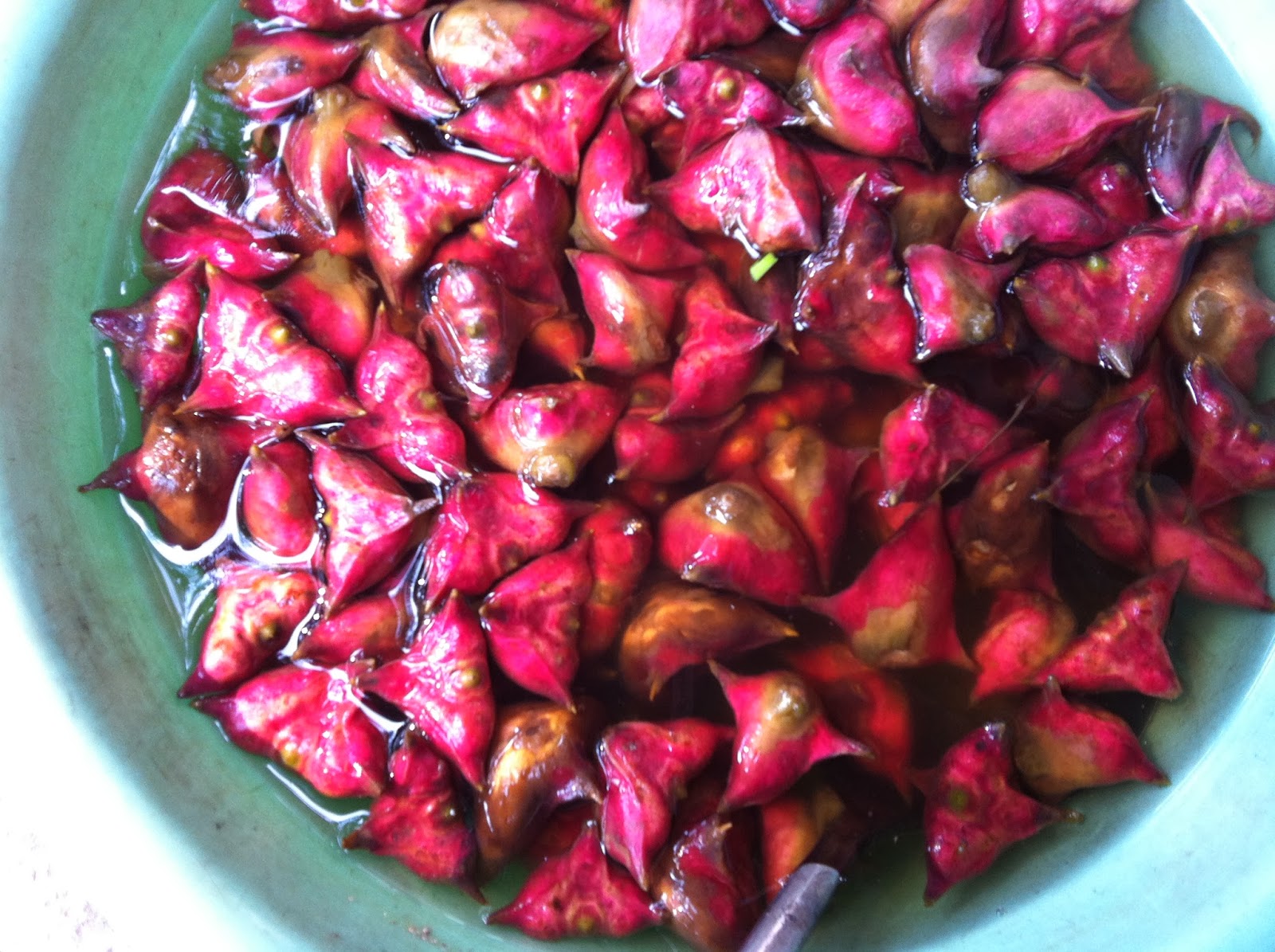
I came across someone selling goose eggs (huge!) and some sort of three-dimensional triangular fruit and my son's favorite thing from China, tea eggs, sold hot.


And a bowl of tetrahedron-shaped fruits that were beautiful but I don't know what they are.


I came across beautiful ornate hair ornaments for women with long black straight elegant Chinese hair.


They did allow me to go into a garden without paying extra. Compared to the gardens I've seen here in Suzhou, even I could tell it was derisory. Not worth a single photo.

In the main plaza there were several groups of young women dancing, which was very instructive.


I watched a few groups of them. It was like a cross between dancing and tai chi – their movements were what I can only call sedate. Well rehearsed, all done in unison, but minimalist movements. And it struck me that this characterizes Chinese traffic too. Lines that divide lanes are only suggestions. Cutting someone off as you turn left or right is normal. Pedestrians weave around cars and cars weave around pedestrians, as do all the motorbikes and scooters and bicycles in their lanes. And there are vast numbers of cars, two-wheeled vehicles, and pedestrians. You'd think there would be accidents galore, but I've seen nothing even close. The reason is that everyone drives sedately! They go slowly enough for everyone else to get out of their way and to take evasive action themselves.

Well, enough of Tongli. Time to go back to Suzhou and fix my money problem.

Back at my hotel, thank goodness I had made a friend of the assistant concierge. “Allen,” his English name, has worked at the hotel since it opened 15 years ago. His English is not as good as my Spanish, so you can imagine how halting it is. He's about 40, as tall and thin as Ichabod Crane: a strong wind would blow him over. He has teeth that would be perfect for a Before picture if only there were an After picture. But he is sincere and kind and friendly and helpful. I explained my problem to him, and this whole thing became a fascinating study in problem-solving. He enlisted another hotel employee to help..

Their proposed solution #1: put my credit card into the ATM machine. I tried to explain why it wouldn't work – there is no password with a credit card – but they didn't get it so I “tried,” with the predictable result.

My proposed solution #2: cash a paper check on my Washington State bank at the hotel. Nope, they can't do that.

Their proposed solution #3: go to a bank and get an advance on my credit card. Allen drives me 200 meters in an airport-style electric cart, we jaywalk like mad across half a dozen lanes of various kinds of traffic, and we go to the bank. He carefully explains the problem to an employee. LONG discussion between them. Finally, no: the bank will not give me an advance on my credit card. Something to do with the presence or absence of some chip, who knows?

My proposed solution #4: what if I overpay my bill to the hotel and they give me the balance in cash? Okay, Allen drives us back to another part of the hotel which may cater to upper-income guests: more English spoken, apparently classier in that part. Two women understand the problem perfectly and slowly and methodically they piece together what happened. The Shanghai hotel's card had a map on the back, so I was able to point out the exact location of the Bank of China branch where I had changed money and left the debit card. I had kept the receipt from the cash transaction, too. With these and a lot of time, they called the bank and determined the debit card was indeed there. Normally banks mail such things back to where they came from but now they are holding the card for my return. That is a huge relief! But the problem with cash now? Still not: it is against hotel policy to advance cash to customers in the way I suggested. All very regretfully! They really felt for me.

My proposed solution #5: Is there a manager high enough up in the hierarchy to make a one-time exception to their policy? Bingo! And they were willing to give me cash against the credit card right then, not when I check out tomorrow. This of course took even more time and they apologized for having to charge 50 RMB for giving me 1,000 RMB in cash, but I thanked them effusively. They printed out a form for me to sign, took a copy of my passport, and gave me 1,000 RMB in cash, more than enough for the next couple of days.

I think this whole process was fascinating in many ways. First, Allen and the other hotel employees were all so eager to help. Even the bank employee was eager to help. They were all so apologetic when they couldn't because their institutions' rules forbade helping. Second, I was the one to come up with the solution: perhaps within an institution it's hard to see around its rules? Or maybe it's the can-do American in me vs. the follow-the-rules Chinese in them? And third, to me the most fascinating of all, was that I was in no way freaking out. I was patient and good-humored and grateful for all the kindness people were so obviously demonstrating to me. Especially once I knew the debit card was safe, I was positive that with all this help surely we'd find some way to get me some cash. And that being the case – and it was! – what was the downside? Missing a couple of hours when I could have been visiting another beautiful Chinese garden? I could live with that. Truly, I do not believe I would have been capable of such equanimity under equal circumstances 20 or 30 years ago, maybe even 10 years ago. A wonderful demonstration of one of the many advantages of getting older. If you can feel the waves of self-congratulation emanating from me, you are absolutely right.

October 11-13, Suzhou


Introduction to the Introduction
Today is November 7 and I am in Hong Kong.  From China I was able to send out this blog, with great difficulty, until I got to Beijing.  Thereafter it became impossible.  I have written every day, though, and will be adding new posts as I catch up to the month I have been here.  The advantage to the disadvantage is that I've been able to add some photos I wasn't able to send earlier.

Introduction

I am writing this Sunday, October 11, the evening I arrived in China, and today I realized I was thinking that this blog is for you. Of course it is, in part, but something Stephen King (of all people) said about writing is important: “Write with the door closed.” If this blog is for you, then I tailor it to fit my idea of your interest and patience level. If it's for me, then I write everything that seems significant to me. This blog will therefore be for me, and I surely will understand and even sympathize that it's far too much for you. That's fine: just skim it and look at the pictures! Or skim those too.

Some structure for comprehension: I am spending my first five days in China on my own because I wanted to see Suzhou and Hangzhou and they were either not included or only briefly on the tour. The tour starts in Shanghai (they call it a “pre-trip” add-on) and Suzhou and Hangzhou are near Shanghai, which is why I started my trip this way. I will meet the “pre-trip” people on the Overseas Adventure Travel tour in Shanghai on October and the majority of the 16-person group in Beijing on October 18 for the main trip.

Saturday, October 12, Suzhou

The morning after I arrived in Shanghai, I repacked some things in my backpack to take for the next five days and checked my suitcase at the hotel, because I will be coming back to the same hotel on the 16th to meet the other six people who also signed up for the Shanghai “pre-trip.”

Then I went to Suzhou – pronounced, I have learned, SuJO. It is a 2,500-year-old UNESCO World Heritage city, like San Miguel, that is famous for its gardens and silk industry, both of which I wanted to see. The trip was unexpectedly arduous. It was hot and humid, my least favorite weather. Although I did one thing right by not having a schedule and therefore not having the stress of meeting it, I had to do a great deal of walking, a good deal of it back-tracking, with the heavy pack on my back, because I can't speak Chinese and they don't speak English. It turns out that foreigners don't get tickets at the station. This means go into the station – through security, upstairs, try to figure it out -- be perplexed, ask someone, sort of, find out where to go, retrace back downstairs against the crowd of people coming in, and go to another building 300 meters up the street, be perplexed, buy the ticket, come all the way back, find the gate, find the train, discover that I had a reserved seat, find the car, find the seat, and collapse. The train itself, although not air-conditioned, was a marvel, my first bullet train. A digital display showed that our maximum speed was 281 km/hour = 175 miles/hour. At the Suzhou train station, more walking and walking to find a taxi. It turns out that after 70 years, back surgery, and with a heavy backpack, walking is not what it used to be! I was so glad I didn't also have to deal with a suitcase.

I learned that I should have made a printout in Chinese of where I was going because it is hard to find people who speak English, let alone Spanish or French: the taxi driver took me to the wrong hotel, where I found someone to translate for him where I wanted to go. Arriving finally at the hotel and sinking down into a chair, I learned this was not the right reception location. More walking. When I checked in someone led me to my room, a long way down a twisty hall. It is lovely but I was exhausted. Well, rest cures that. Here is what it looks like out my window.


The room is as lovely inside as out. Here is the tea service.


In the late afternoon, rested and cooler, I went out to the Pan Gate Garden adjoining the hotel. This town has many classical Chinese gardens, and I am thinking the Chinese must all have wonderful blood pressure levels if they can see gardens like this all the time. The peacefulness of a Chinese garden is extraordinary.

Now can you imagine seeing a sign like this in an American garden, or even a Mexican one?

I came across parents and their daughter feeding the fish –


and then went into the lobby to do email (no room wireless here). Having had enough for one day of intercultural difficulty, I decided to have dinner in the hotel, which has a western and a Chinese restaurant: you can guess which I chose! It was a thick soup with pumpkin, beans, pigeon eggs (that's what hooked me), shrimp, and lily (I have no idea), and it was delicious. Then I read my novel in my room and went to bed. Such was my first day in China.


Sunday, October 13, Suzhou 

Directed to a nearby Chinese restaurant for breakfast, I entered and stood there. It looked like there were half a dozen staff, a couple of people at a table. Staff members walked past me as if I were invisible. There was nothing in me that took this personally (should I have?) because I have read enough about Chinese history to understand that they might not automatically be thrilled to see a Caucasian face. Perhaps they weren't really open for customers? After a few minutes I turned and left, going across the street to a bakery that also served coffee. A pretty ho-hum breakfast for China!

I spent the morning at the Garden of the Master of the Nets, a famous garden in China about a thousand years old. It could not have been more different from the Pan Gate Garden. There were many small gardens, some tiny, designed to be seen from many rooms containing large wooden uncomfortable-looking lacquered furniture built entirely of wood at right angles. To the contrary, there was not a straight line to be seen in any of the gardens, let alone a vertical or horizontal one.

Chinese gardens are all about the importance of nature in the lives of humans. They reproduce mountains, seas, clouds and islands in miniature. There are circular doorways: moon doors. The rocks are created in fantastical shapes, deeply sculptured like no rocks I've ever seen in nature. Some of them I'm told come from a very few lakes prized for their currents that create such forms; some are created by people who cement pieces together. 

Each individual element and groups of elements have their own aesthetic and symbolic character, as if every part of every garden had been created with visual frames, the way artists do with their thumbs and forefingers to get a sense of what a small part of what they are seeing would look like on a canvas. It was a delight to pay attention so carefully.

I once took a course in college that included lectures and pictures of British vs. French gardens, to illustrate the difference in the national characters and their literatures. The British garden is lush, with many plants growing together as if artlessly and as if no human had had any part: think of Virginia Woolf's Sissinghurst. The French garden is the essence of nature organized by humans: think of the garden at Versailles with its rigorously trimmed plants and pathways in perfect geometrical shapes. The Chinese garden is totally different from them both, more wild than the British with the slashing horizontal lines of sculpted pine trees and craggy rocks, and more tamed than the French with its fierce attention to every tiny visual detail.

One of the gardens, of course, contained a lake, a must-have for a Chinese garden. I loved watching so many people sit and paint what they were seeing. They come with a lot of paraphernalia: special small folding stools, a specially designed large canvas bag to hold the hard flat surface they paint on, zippered compartments of different shapes and sizes to hold the ink, brushes, a container for water scooped from the lake, a couple of small dishes for the ink and to remove excess water from the brush.
I sat and watched the artists for a long time. There must have been 25 people painting around that lake, all of whom seemed to be in their 20s or 30s, both men and women.  Next, I had tea at this garden. A small bonsai plant was a centerpiece on the table.

A weekend treat at the hotel where I am staying is dim sum, so of course I came back for that. Imagine, dim sum in China! I had some strange things – stewed chicken FEET with peanuts, which tasted sort of fatty but not greasy, interesting – and several things in steamed rice noodles with various stuffings inside.

 
I am learning, the hard way naturally, how to use chopsticks. It's easier to eat small pieces of meat or vegetable with chopsticks, but ball-shaped things of an inch and a half in diameter is pretty different. Instead of trying to get the chopsticks on both sides of a steamed thing, which is slippery and makes a mess, it turns out it's easier to spear the steamed thing with one chopstick and using the other to steady it. Having achieved that, it's not so easy to get the entire thing into my mouth, a mouth so small that the dentist has to use child-sized X-ray films, but I was determined. It must not have been pretty. For dessert I had several balls of chopped mango mixed with cream inside a rice noodle outside, which in turn was rolled in sugar and chopped coconut.

At the end of the meal the waitress asked me if this was my first trip to China (I thought that would have been obvious to anyone watching me struggle with the chopsticks) and if I was traveling alone. When I replied that I was, she had a fleeting expression of pity that she quickly brought under control. And yet I am loving traveling alone. I cannot imagine trying to see a Chinese garden with anyone else: it is the ultimate solitary experience, since what you look at and how long you spend looking at it are necessarily an individual choice. I recall in the early 90s that after a conference in Paris I rented a car for five days and traveled by myself. It was a miserable failure: I was lonely and stressed and vulnerable and full of self-pity. Now, however, I am tranquil and confident and positive. What a difference twenty years and a lot of learning make …

This afternoon I went to Pingjiang Historical District. This is an old, old neighborhood of alley-streets built along a canal. It was an exercise in visual dissonance. The old buildings are still there, hundreds and hundreds of years old, but the area has become repurposed into a tourist attraction with tourist-oriented shops: clothing, especially silk; food, objets d'art, food, cheap souvenirs, food …


The people-watching was superb: there were thousands of people strolling along, nearly all of them Chinese. In all the thousands I saw exactly four pregnant women, of whom two surprisingly had another child already. How I wished I could ask them about it! Up to now the only families I've seen with more than one child have been those with twins. I just recently read a book on sex selection for males, especially in China and India, countries that are now paying the price with millions of wifeless men. Although it seems I am seeing more boys than girls, the only way to know for sure is to make a proper count. One day this month I hope to do this: I am very curious about it.

Walking along the path next to the canal, I passed homes hidden behind walls, like in San Miguel. Obviously this family had a vegetable garden growing on the other side of the wall.


It was a real mixture of women dressed to the nines, some with Mexican-style suicide shoes (my term for the super-high platform heels) and elegant dresses with matching shoes, others in jeans and t-shirts. All, however, had shoes that looked new and perfect, which instantly made me feel shabby. Some of them had dogs on leashes, mostly small dogs but all perfectly groomed fluffy things. There is definitely an air of prosperity about these folks.


In addition to the people strolling along the alley next to the canal, with maybe eight feet of side-to-side walking space, there were many people on bikes and motorbikes and scooters. I have noticed in taxis that the part of the car used most, next to the gas pedal, is the horn, often for reasons that are mysterious to me. It was the same in the alley: beep, beep, beep! Picture an airport full of people and the electric cars trying to get through from behind.

Electric cars! Like Sherlock Holmes' dog that didn't bark in the night, I suddenly realized that I was NOT hearing any sounds from the all these vehicles: they are all electric! No motor roar, no exhaust smell. No wonder the sky here seems so clear – at least half the people travel on two-wheeled vehicles of various kinds in their own lanes on the streets, and making them all electric must help the air quality a lot. I did see a few people riding along with face masks, though. This picture was taken that evening back in Suzhou.